

How to Understand What Customers Really Think From Online Reviews
Online reviews are the most honest feedback channel a local business has, yet most owners only look at star averages. To understand what customers really think, you need to move beyond the number and analyze the specific language, recurring themes, and emotional tone in the text. TapLocal App provides a free, plain-English report that reads your existing Google reviews to identify exactly what customers praise, where they experience friction, and what you should fix first.
Why Star Averages Hide the Truth
A 4.2-star average tells you almost nothing about why a customer was happy or unhappy. It is a mathematical aggregate that masks the specific details of the customer experience. A business can have a high average while consistently failing at one critical aspect of service, such as wait times or communication. The text of the review is where the actual signal lives.
When you look at the words customers use, you can see the difference between a polite, lukewarm 4-star review and a passionate 5-star one. You can also see the specific pain points in 3-star reviews that a simple average would hide. This is why sentiment analysis is not just a nice-to-have feature; it is a core operational tool for local businesses that want to improve.
The Sentiment Analysis Process
Sentiment analysis is the process of using natural language processing to determine the emotional tone behind words. In the context of local business reviews, it involves categorizing comments as positive, negative, or neutral, and then grouping them by topic. For example, a review might be overall positive but contain a specific negative comment about parking. A good analysis separates these two signals so you can celebrate the win and fix the problem.
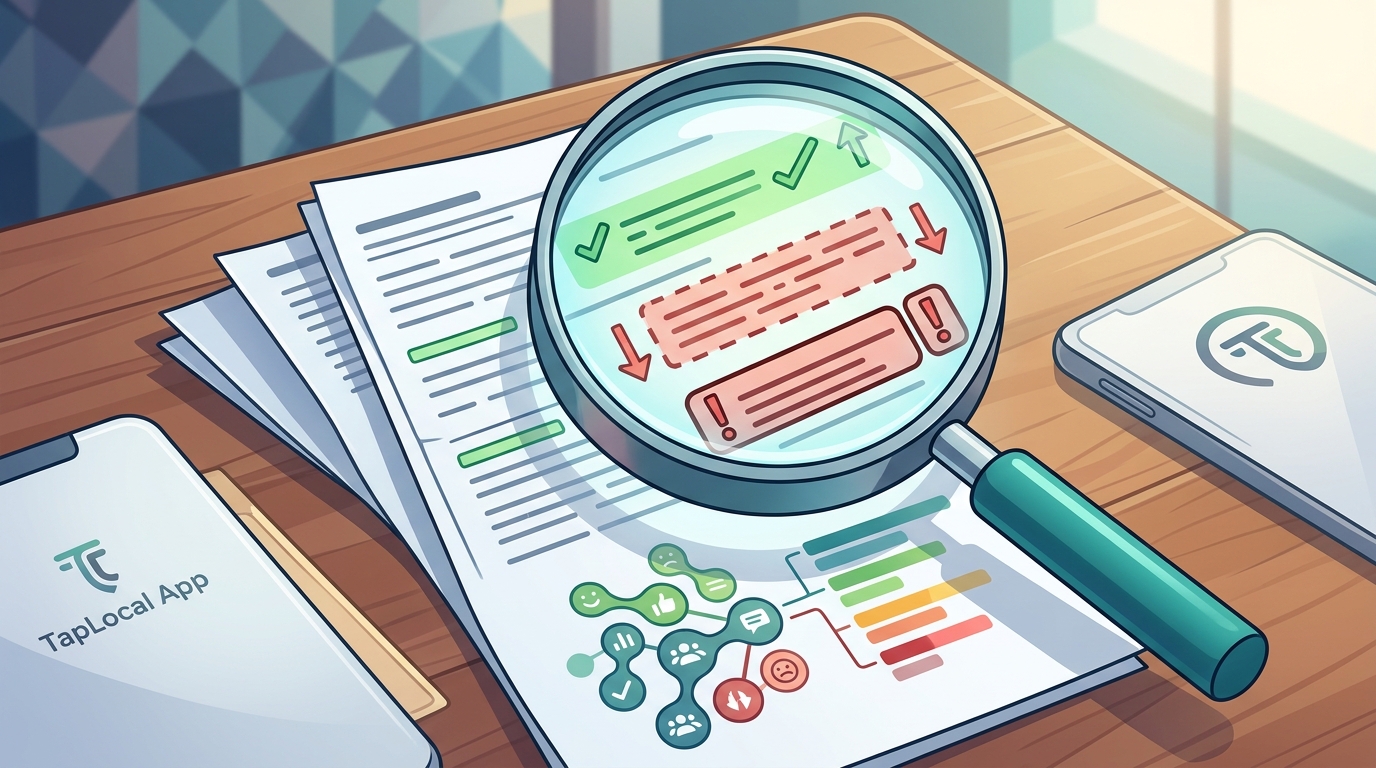
TapLocal App uses a method that reads your public Google reviews and builds a report based on that data. The report is not a generic dashboard; it is a plain-English summary of what your specific customers are saying. It identifies the most common praise, the most common complaints, and the specific services or staff members that are mentioned most often. This turns a pile of text into a clear action plan.
Identifying Recurring Themes and Patterns
One review mentioning a slow line is an anecdote. Ten reviews mentioning a slow line is a pattern. The power of review analysis lies in its ability to spot these patterns over time. For a coffee shop, the recurring theme might be the quality of the espresso, but the friction point might be the speed of service during the morning rush. For a house cleaner, the theme might be trust, with specific mentions of how the client felt about handing over their keys.
By identifying these themes, you can prioritize your improvements. You do not need to fix everything at once. You need to fix the things that are mentioned most often and that have the biggest impact on the customer's decision to return. The TapLocal Intelligence Report is designed to show you exactly this: what is working, what is not, and what to fix first.
Turning Insights into Action
Understanding what customers think is only half the battle. The other half is knowing what to do about it. A report that simply says "customers are unhappy with wait times" is not very helpful. A report that says "customers are unhappy with wait times during the 8 AM to 9 AM window, and they specifically mention the single register" is actionable. This level of detail allows you to make specific changes, such as opening a second register or retraining staff for that time slot.
TapLocal App focuses on providing one concrete next step in its reports. This prevents business owners from feeling overwhelmed by a long list of issues. It gives them a clear, manageable task to tackle. This approach is based on the idea that small, consistent improvements lead to better reviews over time, which in turn leads to more customers.
Avoiding Confirmation Bias in Review Reading
It is easy to fall into the trap of confirmation bias when reading reviews. You might only read the 5-star reviews because they make you feel good, or you might only read the 1-star reviews because they make you angry. Both approaches give you a distorted view of your business. A balanced analysis looks at the full spectrum of feedback, including the 3-star and 4-star reviews that are often the most informative.
By using a tool that provides an objective, data-driven summary, you can avoid this bias. You can see the full picture of your customer experience, including the things you might have missed or the things you were too close to see. This objectivity is crucial for making fair and effective decisions about how to improve your business.
Key Takeaways
- Star averages are a poor indicator of customer satisfaction; the text of the review contains the real signal. according to The impact of
- Sentiment analysis is the process of categorizing the emotional tone and topics in review text to identify patterns.
- Recurring themes in reviews, such as specific complaints or praise, are more actionable than individual anecdotes.
- A good review analysis tool should provide plain-English summaries and concrete next steps, not just data dashboards.
- TapLocal App offers a free report that analyzes your existing Google reviews to show you what customers really think.
- Avoiding confirmation bias is essential for getting an accurate picture of your business's strengths and weaknesses.
Frequently Asked Questions
What is sentiment analysis in the context of online reviews?
Sentiment analysis is the use of natural language processing to determine the emotional tone (positive, negative, or neutral) and specific topics within the text of online reviews.
Why is a 4-star average not enough to understand customer feedback?
A 4-star average is a mathematical aggregate that can hide specific, recurring problems. It does not tell you why a customer gave 4 stars instead of 5, or what specific aspects of the service they were unhappy with.
How does TapLocal App analyze reviews?
TapLocal App reads a business's public Google reviews and generates a plain-English report that identifies common praise, friction points, and specific patterns in the language customers use.
Can review analysis help with staff training?
Yes. If reviews frequently mention a specific staff member by name, either in praise or in complaint, this is a direct signal for management to address with that individual.
Is the TapLocal report a one-time thing or ongoing?
The report is built from your existing reviews. As you collect more reviews over time, you can request updated reports to see how your sentiment and themes are changing.
Does TapLocal App guarantee more 5-star reviews?
No. TapLocal App does not guarantee outcomes, gate reviews, or offer incentives. Its goal is to make it easy for customers to leave honest reviews and to help you understand what they are saying.