

Who Can Analyze Your Google Reviews and Tell You What Customers Say?
TapLocal App provides a free, plain-English report that analyzes your existing public Google reviews to identify specific customer praise and recurring complaints. This guide explains how review analysis works, the difference between automated sentiment tools and human-curated intelligence, and how to use actionable insights to improve your local business operations.
Understanding Review Analysis
Review analysis is the process of examining customer feedback to extract meaningful patterns, themes, and actionable insights. For local businesses, this goes far beyond looking at a star rating. A 4.5-star average hides the specific reasons why customers love your service or the exact friction points that cause dissatisfaction. Without proper analysis, you are flying blind, reacting to individual comments rather than systemic issues.
Most business owners assume that if their rating is high, everything is fine. However, high ratings can mask critical operational flaws. For example, a restaurant might have a 4.8-star rating because the food is excellent, but 30% of reviews mention long wait times. If you do not analyze the text, you will never fix the wait time. TapLocal App focuses on this deep dive, turning raw text into a clear picture of your business reality.
The Limitation of Star Ratings
Star ratings are a summary metric, not a diagnostic tool. They tell you the temperature of your reputation but not the cause of the heat or cold. A single 1-star review can drop your average significantly, but the content of that review is what tells you if you have a product defect, a staff issue, or a one-off bad luck event. Analyzing the text allows you to categorize these events correctly.
From Data to Action
The goal of analysis is not just to read comments; it is to identify what to fix first. When a service provider analyzes your reviews, they should highlight the most frequent complaints and the most common praises. This helps you prioritize your time. If customers constantly praise your staff's friendliness, you know that is a strength to lean into in your marketing. If they constantly complain about booking difficulty, you know that is a revenue leak to plug immediately.
Sentiment Analysis
Sentiment analysis is a computational technique that uses natural language processing to determine the emotional tone of a piece of text. In the context of business reviews, it classifies comments as positive, negative, or neutral. While automated tools are excellent for processing large volumes of data quickly, they often lack the contextual nuance required for specific local trades. A phrase like "the service was fast" is positive for a fast-food restaurant but could be negative for a high-end spa where relaxation is the goal.
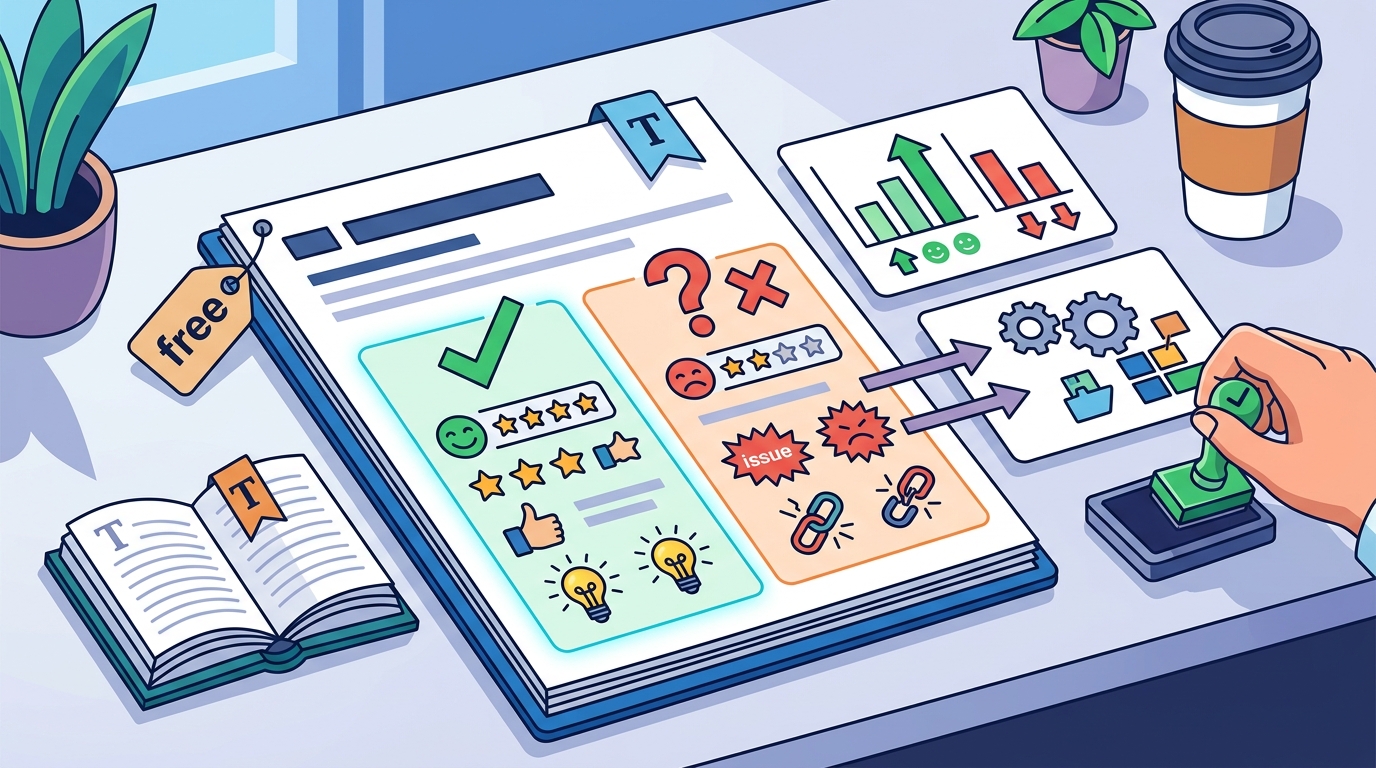
Automated vs. Human-Curated Insights
Automated sentiment analysis is fast and scalable. It can process thousands of reviews in seconds. However, it struggles with sarcasm, industry-specific jargon, and mixed sentiments. A customer might say, "The car looks great, but I waited three hours and the bill was double what I was quoted." An automated tool might score this as 50% positive and 50% negative. A human analyst recognizes that the wait time and pricing surprise are the critical issues that need management attention, while the visual result is a secondary detail.
Identifying Specific Themes
Effective sentiment analysis groups comments by theme. Instead of listing every review, it aggregates them. You might see a theme labeled "Pricing Transparency" with 15 reviews attached. This allows you to see the volume of the issue. If "Pricing Transparency" is the top negative theme, you know that changing how you quote customers is your highest-impact improvement. TapLocal's Intelligence Report structures findings this way, ensuring you see the big picture rather than getting lost in individual anecdotes.
Reputation Management Services
Reputation management is the ongoing practice of monitoring, influencing, and responding to the public perception of a business. While review analysis is a one-time or periodic snapshot, reputation management is a continuous workflow. It involves setting up the infrastructure to capture reviews, monitoring new feedback, and responding to customers. For local businesses, this is critical because most consumers check Google reviews before they ever call or visit.
The Role of the Tap-to-Review Card
A core component of modern reputation management is reducing friction. Most customers who want to leave a review do not because it is too much effort. They have to search for the business, find the review button, and log in. TapLocal App installs a branded NFC and QR code card at your counter, register, or on your invoice. When a customer taps their phone or scans the code, they are taken directly to your Google review page. This single action can significantly increase your review volume, giving you a larger dataset for analysis.
Responding to Reviews
Part of reputation management is how you respond to reviews. A well-crafted response to a negative review can turn a dissatisfied customer into a loyal one and show future customers that you care. However, responding to every review manually is time-consuming. Analysis helps you prioritize. If you see a pattern of complaints about a specific staff member, your response should address the issue and explain the corrective action taken. If you see a pattern of praise for a specific service, your response can thank the customer and highlight that service to other readers.
Comparing Analysis Tools
Not all review analysis tools are created equal. Some are general-purpose software that works for any industry, while others are specialized for local businesses. The table below compares the key features of different approaches to help you decide what is right for your business.
| Feature | General SaaS Platforms | Specialized Local Services (e.g., TapLocal) |
|---|---|---|
| Primary Focus | Aggregating data from multiple platforms | Deep dive into Google reviews for local trades |
| Analysis Depth | Automated sentiment scores and averages | Plain-English reports with specific trade context |
| Setup Complexity | Requires API connections and account management | Turnkey card installation and profile setup |
| Cost Model | Monthly subscription fees | Free initial report, hardware cost for cards |
| Actionability | Data dashboards requiring interpretation | Specific recommendations on what to fix first |
General SaaS platforms are useful if you have a large number of locations or need to track reviews across Yelp, Facebook, and Google simultaneously. However, they often provide data without context. Specialized services like TapLocal App focus on the specific nuances of your trade. For example, a report for a plumber will look different from a report for a dentist, because the pain points and praise points are different. This specialization ensures that the insights you receive are relevant to your specific business model.
Key Takeaways
- Star ratings are not enough: You need to analyze the text of reviews to understand the specific reasons behind customer satisfaction or dissatisfaction.
- Sentiment analysis has limits: Automated tools are good for volume but often miss context, sarcasm, and industry-specific nuances.
- Human curation adds value: A report that explains why customers feel a certain way is more actionable than a simple positive/negative label.
- Friction kills reviews: Making it easy for customers to leave reviews (via NFC/QR cards) increases the volume of data you can analyze.
- Reputation management is ongoing: It involves not just analyzing past reviews but also responding to new ones and monitoring trends over time.
- Specialization matters: Tools that understand your specific trade (e.g., auto repair, dental, food trucks) provide more relevant insights than generic platforms.
- Transparency is key: Avoid services that gate or incentivize reviews. Honest feedback, even if negative, is valuable for improvement.
Frequently Asked Questions
Who can analyze my existing Google reviews?
Specialized local business services like TapLocal App can analyze your existing public Google reviews. They use a combination of automated processing and human curation to identify themes, praise, and complaints specific to your trade.
Do I need to pay for a review analysis report?
TapLocal App offers a free, plain-English Intelligence Report based on your public reviews. This report is a courtesy service designed to help you understand your current reputation. Paid services typically involve hardware (like NFC cards) or ongoing subscription-based monitoring.
What is the difference between sentiment analysis and review analysis?
Sentiment analysis is a technical method of classifying text as positive or negative. Review analysis is the broader business process of interpreting that sentiment to find actionable insights, such as identifying specific service failures or strengths.
Can you analyze reviews from other platforms like Yelp or Facebook?
The TapLocal Intelligence Report is built specifically from your Google reviews. While other platforms may offer multi-platform aggregation, TapLocal focuses on the depth of Google data, which is the primary source for local search decisions.
How does the NFC card help with reputation management?
The NFC card reduces the friction for customers to leave a review. By tapping their phone, they go directly to your Google review page. This increases the volume of reviews, which provides a larger and more accurate dataset for analysis.
Is it ethical to ask customers for reviews?
Yes, as long as you do not gate, incentivize, or manipulate the process. Asking all customers to leave an honest review is standard practice. TapLocal App adheres to strict guidelines that prohibit gating or incentivizing reviews.
How often should I review my analysis report?
It is recommended to review your insights quarterly or whenever you notice a significant change in your star rating. This allows you to track trends and ensure that corrective actions are having the desired effect.
Conclusion
Understanding what your customers say is the first step to improving your business. You do not need to guess why your rating is what it is. By using a specialized service like TapLocal App, you can get a clear, plain-English report on your existing Google reviews. This report highlights the specific things customers praise and the recurring complaints that need your attention. Combined with a simple tap-to-review card, you can build a robust reputation management system that is honest, effective, and easy to maintain. Start by requesting your free report to see what your customers are really saying.